
Blogs
Biker Jacket Women: How to Style the Edgy Classic

There is a reason the biker jacket women keep coming back to has outlasted almost every other outerwear trend of the last century: it does the hard work for you. Throw it over a summer dress and the outfit reads sharper. Layer it under a wool coat and the whole look gains structure. At Shop Leather Jackets we see the same pattern every season, which is that the biker is rarely bought as a novelty and almost always bought as a spine piece that the rest of the wardrobe organises itself around.
What Actually Makes a Jacket a Biker
The silhouette is not vague. It has rules, and understanding them helps you tell a proper biker from a cropped leather jacket with a zip stitched down the middle.
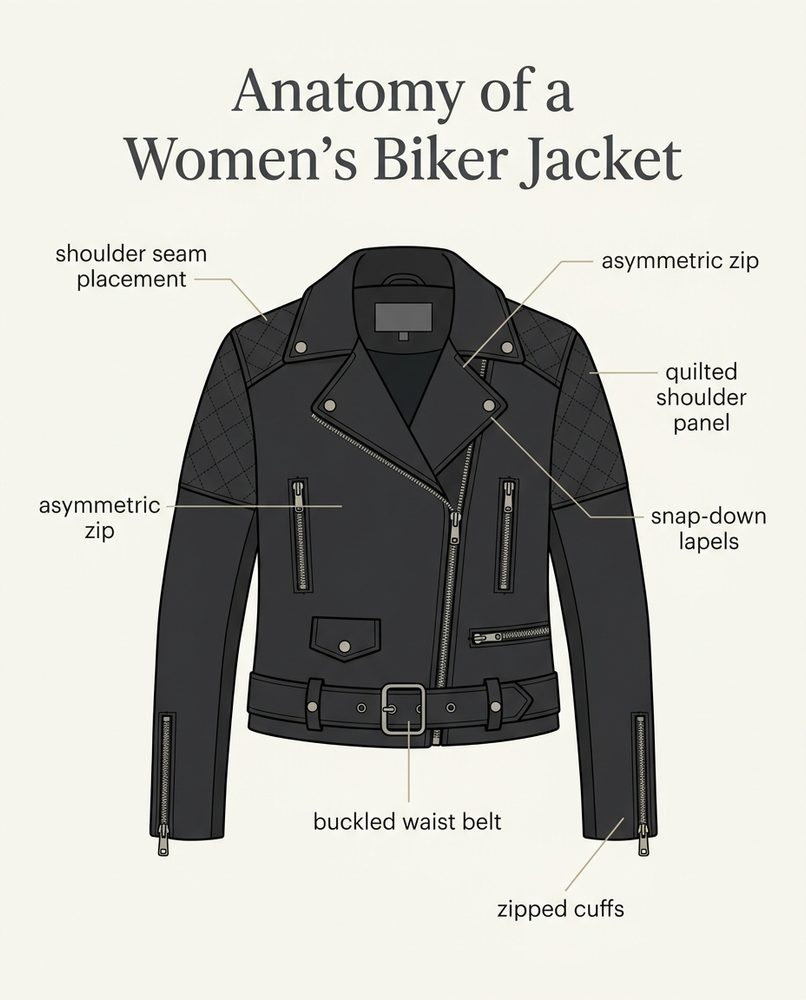
The asymmetric zip and belted waist
The defining feature is the off-centre zip that runs diagonally across the chest, a detail that came from function rather than fashion. Riders leaning forward over a tank needed a closure that would not dig into the sternum or gape open at speed. The same logic produced the snap-down lapels, the zipped cuffs and the buckled waist belt. The Museum at FIT’s costume archive traces the whole template back to the original Perfecto of 1928, and almost every jacket in the womens biker jacket category still carries those four markers.
How the women’s cut differs
A ladies cut is not simply a men’s pattern scaled down. The shoulder seam sits narrower and slightly further in, the armhole is higher so the sleeve moves independently of the body, and the waist is suppressed through the side seams rather than relying on the belt alone. Lapels tend to be smaller in proportion so they do not swamp a narrower frame. Sleeve length is shorter and the cuff sits at the wrist bone, which matters enormously if you plan to wear the jacket with anything long-sleeved underneath. The best test is to raise both arms in front of you. A well cut ladies biker jacket will lift at the hem, not pull across the back.
Choosing the Right Leather Biker Jacket
Before styling comes selection, and this is where most people either fall in love with a jacket that fights them or find one they wear for a decade.
Leather types and finishes
Lambskin is the softest of the common options. It drapes almost like a heavy fabric, breaks in within a few wears and suits anyone who wants the jacket to feel light on the shoulders from day one. Lambskin leather does mark more easily than cowhide, which is part of its charm once the surface starts to develop character. Cowhide and goatskin sit heavier, hold a more architectural shape and take longer to soften, which is exactly what some people want.
Finish changes the mood as much as the hide does. A waxed or distressed surface reads lived-in and casual. A smooth aniline finish reads polished and works better with tailoring. Quilted detailing across the shoulders and forearms adds visual texture without adding bulk, and jackets with quilted panels tend to photograph well because the stitching catches the light.
On sourcing, it is worth knowing that the leather industry has its own environmental certification framework. The Leather Working Group audit standard rates tanneries on water use, chemical management, energy and traceability, and it has become the reference point most serious buyers use when asking questions about a supply chain.
Fit, length and shoulder line
Three measurements decide whether a biker works on you. The shoulder seam should land on the outer edge of your shoulder bone, not below it. The hem should finish at or just above the widest point of your hip. The sleeve should end at the wrist, not over the hand.
Cropped bikers create a longer leg line and pair naturally with high-waisted trousers and skirts. Longline versions, such as a longline belted biker jacket, cover more of the hip and work better over dresses or with slim trousers. Neither is more correct. It depends on where you want the eye to stop.
If you are shorter than around 5ft 3in, a cropped body with shorter sleeves prevents the jacket from wearing you, and the ladies petite jackets range is cut on adjusted proportions rather than shortened sleeves alone. A petite black biker jacket in a clean finish is about as versatile as outerwear gets. At the other end, tall womens jackets add length through the body and arm so the waist seam still lands where it should. For anyone who prefers a closer line through the torso, the slim fit jacket womens cut removes excess through the ribcage without restricting the shoulder.
Hardware, lining and the details that date a jacket
Hardware is the fastest way to judge quality without touching the leather. Zips should run without catching, both on the main closure and on the cuffs and pockets, and the pull tabs should feel weighted rather than tinny. Antique brass and gunmetal read warmer and more vintage. Polished silver reads sharper and more contemporary. Gold hardware has become far more common on women’s bikers in recent seasons and lifts a plain black body considerably.
Check the lining as well. A full lining rather than a partial one means the jacket slides cleanly over knitwear instead of dragging, and a quilted or satin lining adds a little insulation without bulk. Look at where the seams meet at the collar and the belt loops, since sloppy finishing shows up there first.
Small design choices also determine how long a jacket stays wearable. Oversized epaulettes, heavy studding and contrast panels all tie a piece to a specific moment. Restrained hardware and a clean body do not. That is why a piece like the off-white biker style jacket, which keeps its detailing minimal, tends to outlast heavily decorated alternatives in a working wardrobe.
Colour beyond black
Black is the default for good reason. It absorbs hardware, hides wear and disappears into any palette. A black leather jacket women can build an outfit around will never look wrong, and a piece like the black asymmetrical biker style jacket is the closest thing to a uniform this category has.
Brown is the underrated alternative. Tan, cognac and chocolate soften the silhouette and read warmer against most skin tones, and a brown leather jacket women choose over black tends to pair more easily with camel, cream and olive. The tan quilted biker jacket and the cognac quilted version both sit in that middle ground between edge and warmth. Deeper shades like burgundy and forest green behave almost like neutrals in practice while still registering as a deliberate choice.
How to Style a Womens Biker Jacket
The biker earns its keep through contrast. Put it against something soft, fluid or formal and both pieces improve.
Over dresses
This is the pairing that made the jacket a wardrobe staple rather than a subculture signal. A slip dress, a floral midi or a knitted column dress all gain shape under a cropped biker. Keep the jacket open and let the dress do the talking. For midi and maxi lengths, a cropped body is usually better because it keeps the waist visible. If the dress is already fitted, a slightly roomier jacket stops the outfit reading too tight overall.
Boots finish it. Ankle boots for daytime, knee-high for colder months, and trainers if you want to pull the whole thing towards weekend rather than evening.
With tailoring
A biker over a suit is one of the most reliable modern outfit formulas going. Wide-leg trousers, a crisp shirt and a cropped leather jacket produces something more interesting than a blazer would. The key is proportion: if the trousers are voluminous, keep the jacket close to the body. Choose a smooth finish rather than heavily distressed leather when tailoring is involved, since the two textures need to look intentional together. A piece like Carrie in clean black leather handles this transition without effort.
With denim and knitwear
Leather and denim is the oldest pairing in the book and still works, provided the tones are separated. Pair a black biker with mid or light-wash jeans rather than matching darks. Underneath, a fine-gauge roll neck, a striped long-sleeve tee or an oversized jumper all sit well. Chunky knits need a jacket with enough room through the chest, so size up or choose a moto leather jacket with a slightly relaxed body.
Across the seasons
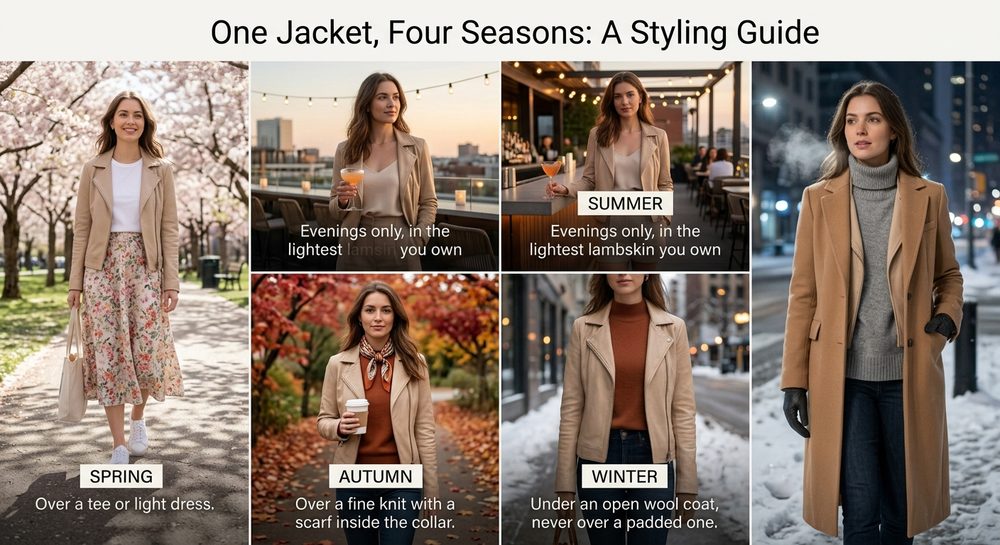
The biker is genuinely a four-season jacket in the British climate, which is more than can be said for most outerwear. In spring it goes straight over a tee or a light dress with nothing underneath. In summer it lives on the back of a chair and comes out for evenings, which is when a lighter lambskin body earns its place.
Autumn is where it performs best, layered over a fine knit with a scarf tucked inside the collar. Winter needs a strategy. Because the body is close-fitting, adding bulk underneath rarely works, so the better approach is to layer over the top with a long wool coat left open, or to size the jacket with a merino base layer in mind from the start. A purple modern fit biker jacket or any slightly roomier body handles that winter layering more comfortably than a tightly cut one.
One jacket, four seasons. Spring: over a tee or light dress. Summer: evenings only, in the lightest lambskin you own. Autumn: over a fine knit with a scarf inside the collar. Winter: under an open wool coat, never over a padded one.
For evening
Silk, satin, sequins and leather is a combination that never feels forced. A biker thrown over an evening dress reads as confidence rather than compromise, and it solves the perennial problem of what to wear over something delicate when the temperature drops. Push the sleeves up slightly, keep the belt loose or tucked behind, and let hardware be the only jewellery you need above the neck.
The V&A holds a customised ladies’ biker jacket made in London in 1990, trimmed with steel and bicycle chain, which is a useful reminder that this silhouette has always invited personalisation rather than demanding uniformity.
Biker, Bomber, Racer or Shearling
Bikers are often shortlisted alongside three other silhouettes. This is how they differ in practice.
| Style | Silhouette | Best worn with | Overall mood |
|---|---|---|---|
| Biker | Cropped, asymmetric zip, belted waist | Dresses, tailoring, denim | Sharp and structured |
| Café racer | Minimal, central zip, banded collar | Knitwear, slim trousers | Clean and understated |
| Leather bomber jacket women | Relaxed body, ribbed hem and cuffs | Jeans, hoodies, trainers | Casual and easy |
| Shearling jacket women | Heavier, wool-lined, warm collar | Winter layers, boots | Cosy and substantial |
If you are still weighing options, our biker jacket buying guide covers construction and hardware in more depth, while the wider guide to styles of leather jackets maps the full range. For outfit inspiration across the whole category, our piece on women with leather jacket styling goes further into seasonal pairings.
Looking After It
Real leather rewards very little maintenance, but it does want the right kind. Hang the jacket on a broad wooden or padded hanger so the shoulders keep their shape. Avoid direct heat, radiators and prolonged sunlight, all of which dry the hide and cause cracking along fold lines.
Wipe surface marks with a barely damp cloth and let the jacket dry naturally at room temperature. Condition once or twice a year with a product made for garment leather, applied thinly and buffed off. Never machine wash. For anything beyond light surface cleaning, use a specialist leather cleaner rather than a standard dry cleaner.
Rain is not the disaster people assume. Let a wet jacket dry flat, away from heat, and the leather will recover. Storing it in a breathable cotton cover rather than plastic prevents moisture being trapped against the surface over summer. Browse the full leather jacket women collection if you are ready to choose one.
Frequently Asked Questions
-
What should I look for when buying a biker jacket for women?
Start with the shoulder seam, which should sit exactly on your shoulder bone, then check the hem lands at or just above the hip and that the sleeve finishes at the wrist. Look for a smooth-running metal zip, a full lining and even stitching along the seams. Real leather will feel supple and smell faintly of hide rather than chemicals.
-
Are biker jackets still in style?
Yes, and the evidence is that the silhouette has been continuously worn since 1928 without ever fully leaving fashion. Details rotate, with cropped lengths, longline versions and quilted panels each having their moment, but the core shape is treated as a permanent wardrobe piece rather than a trend. That stability is exactly why it tends to be a sensible long-term buy.
-
What can I wear a leather biker jacket with?
Almost everything. Dresses of any length, tailored trousers, jeans, skirts and knitwear all work, because the jacket relies on contrast. The most reliable formula is to pair its structure with something soft or fluid underneath. Avoid layering it over heavy padded pieces, which fight the fitted shoulder line and make the whole outfit read bulky.
-
Should I size up or down in a leather jacket?
Take your true size in most cases. Leather stretches slightly with wear, particularly lambskin, so a jacket that feels snug but not restrictive when you first zip it will settle within a few weeks. Only size up if you intend to wear chunky jumpers underneath regularly. Sizing down almost always causes pulling across the back and shoulders.
-
Is black or brown better for a first leather jacket?
Black is the safer first purchase because it works with every palette and hides wear. Brown, tan and cognac are warmer and often more flattering against fair or olive skin, and they pair beautifully with camel, cream and denim. If you already own black outerwear, brown gives you something genuinely different rather than a duplicate.
-
How do I know if a jacket is real leather?
Real leather has an irregular grain pattern, warms to the touch and creases softly rather than folding sharply. The cut edges look fibrous rather than uniform. Product descriptions should state the hide type, such as lambskin or cowhide, rather than vague terms. If you have questions about a specific piece, our FAQs page covers materials and construction.
-
How long does delivery take and can I return it?
Orders are dispatched within seven business days, with total delivery typically taking ten to fourteen business days across the UK and our selected EU markets, and full details are set out in our shipping policy. You have fourteen days from receipt to change your mind under the Consumer Contracts Regulations, and the process is explained in our returns policy.
Pick the one you will actually reach for on a Tuesday morning, not the one that only works for a night out.