
Blogs
Brown Suede Jacket: How to Style a Wardrobe Staple

Suede occupies a strange middle ground in outerwear. It is leather, but it behaves nothing like the smooth, structured hide most people picture when they hear the word. It is soft, matte and quietly expensive-looking, and in brown it becomes one of the few pieces that reads equally well with denim on a Saturday and with tailoring on a Tuesday. At Shop Leather Jackets we get asked about brown almost more than any other colour, and suede is where a lot of those conversations end up.
What Suede Actually Is
Understanding the material explains almost everything about how the jacket behaves, how it should be worn and why it needs different care.
Nap, splits and nubuck
Suede comes from the underside of the hide rather than the outer grain. That inner surface is buffed until the fibres lift, creating the soft nap that gives suede its texture and its slightly shifting tone as light moves across it. Lamb and goat produce the finest, closest nap. Cow splits produce a shaggier, more rugged one.
Nubuck is often confused with suede but is not the same thing. Nubuck is sanded on the outer grain side, so it keeps more of the hide’s strength while gaining a light velvet surface. It is tougher than suede and slightly less soft. If a listing says nubuck, expect something closer to a smooth jacket in weight and durability.
Because suede lacks the protective outer grain, it is more absorbent and marks more easily. This is not a flaw in the material, it is the trade-off that buys you the texture.
Why brown suits suede so well
Suede scatters light rather than reflecting it, which flattens colour and pulls everything slightly warmer. Black suede can look dusty. Bright colours can look chalky. Brown, on the other hand, gains depth. The nap creates variation across the panels that a smooth finish simply cannot produce, and the result is a colour that shifts subtly across the shoulders and sleeves as you move.
This is why so much of the historic record is brown. The V&A holds a brown suede safari jacket made by Aquascutum in Britain around 1972, unlined, top-stitched and belted, which is essentially the template that keeps returning every few years. The New Zealand Fashion Museum holds a 1970s suede jacket with a contrasting leather collar from the same period, showing how commonly the two materials were mixed.
The Main Brown Suede Styles
Suede is a finish rather than a silhouette, so almost any jacket shape can be made in it. Four dominate.
The trucker and western cut
Square shoulders, a straight body ending at the hip, chest pockets with flaps and often a yoke across the back. This is the most recognisable suede jacket shape and the most forgiving to wear. It sits comfortably over knitwear, works open or buttoned, and reads casual without reading scruffy.
The blazer and shirt jacket
The smartest end of the range. A single-breasted suede blazer with a notch lapel does the job of a jacket and a coat at once, particularly in autumn. Shirt jackets, cut with a soft collar and patch pockets, sit between a shirt and outerwear and layer under a wool coat without bulk. Both work best in a mid to dark brown, since lighter tans can look washed out against tailoring.
The bomber and aviator
Suede bombers keep the ribbed collar, cuffs and hem of the traditional shape but swap the sharp finish for something softer. Aviator styles pair suede on the outside with shearling on the inside, which is where the material meets its warmest application. If you want that heavier winter version in leather rather than suede, the brown shearling jacket mens range covers the same territory.
The moto cut
A biker silhouette in suede loses most of its aggression. The asymmetric zip and belt stay, but the matte surface softens the whole effect, which suits people who like the shape and not the shine. For the equivalent in smooth hide, something like the distressed brown biker or the chocolate brown quilted biker shows how differently the same cut reads once the finish changes.
Detailing that dates fastest
Suede invites decoration, and decoration is what ties a jacket to a particular year. Heavy fringing across the back and sleeves belongs to a specific revival cycle and looks dated the moment that cycle passes. Whipstitching, contrast piping, oversized western yokes and wide 1970s lapels behave the same way. None of them are wrong, but they are choices you commit to rather than choices you can wear quietly for a decade.
The details that survive are the plain ones: a clean yoke, flat patch pockets, matte or horn buttons, minimal hardware. Suede already carries texture, so anything added on top competes with the surface rather than complementing it. The same restraint applies in smooth leather, where quiet pieces like the dark brown asymmetrical moto or the coffee brown distressed café racer tend to outlast heavily worked alternatives.
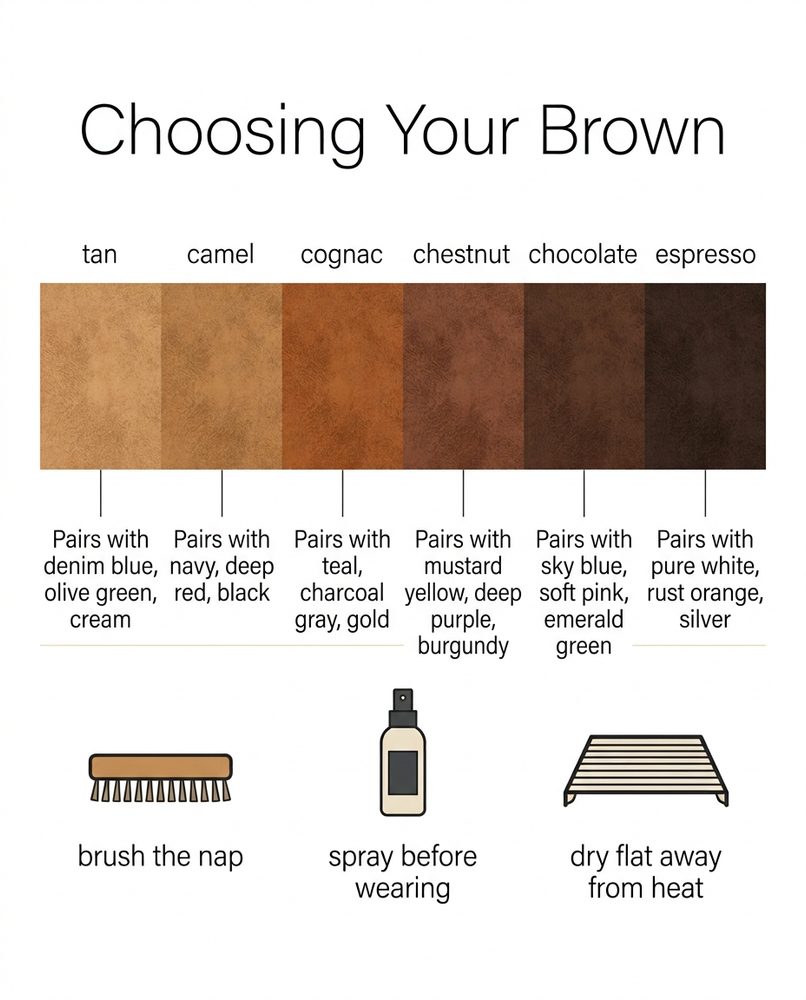
Choosing Your Shade of Brown
Brown is not one colour, and the difference between shades matters more in suede than in smooth leather because the nap lightens everything by a fraction.
Tan and camel
The lightest end. Warm, summery and the most flattering against fair and olive skin, but the least forgiving of marks and rain. Tan suede reads relaxed rather than smart, so it belongs with denim, cream and khaki rather than with a suit. In smooth leather the equivalent tones sit in the tan and camel brown families, as on the camel brown moto jacket and the camel brown café racer.
Cognac and chestnut
The middle of the range and the most versatile. Rich enough to look deliberate, light enough to keep warmth. Cognac suede is the shade that works with almost everything, including navy and grey, which lighter tans struggle with. If you are only ever buying one brown jacket, this is the safest place to land.
Chocolate, coffee and espresso
The deepest tones behave almost like a neutral. They read smarter, hide marks better and sit comfortably with black, which is something lighter browns rarely manage. Chocolate suede under a charcoal overcoat is one of the most understated combinations in menswear. The dark brown, coffee brown and chocolate brown shades work the same way in smooth leather, as does the mocha family.
Shortcut. Buying your first brown? Go cognac. Buying your second? Go chocolate. Tan is the third one, not the first.
How to Style a Brown Suede Jacket
The rule that governs everything: suede supplies the texture, so nothing else in the outfit needs to.
For women
The brown suede jacket womens wardrobes lean on most is the one that goes over things that move. A floral midi dress, a pleated skirt, a slip dress in cream or rust. The soft finish stops the contrast from looking harsh in the way a glossy biker sometimes does. Over jeans, keep the wash mid to light so the two textures separate, and add a cream or oatmeal knit underneath.
For the smart version, wear a suede blazer over wide-leg wool trousers with a fine roll neck. Boots in a different brown are fine and often better than matching exactly; a tonal mismatch reads more considered than a perfect match. If you want the same silhouette in smooth leather, the womens jackets range covers the equivalent cuts, and the petite brown waxed leather coat shows how the colour behaves in a longer length.
For men
Brown suede solves the problem of what to wear when a blazer is too much and a hoodie is not enough. Over a plain crew neck and dark denim it does almost all the work. Over an oxford shirt and chinos it edges into smart casual without tipping into formal.
Avoid pairing brown suede with brown shoes in the same tone, which flattens everything. Contrast the depths instead: light suede with dark boots, chocolate suede with tan boots. For heavier winter options in leather, the mens jacket collection includes long cuts such as the tall camel brown trench coat, which layers over a suit better than any short jacket will.
Colours that sit well alongside
Cream, oatmeal, ivory and off-white are the easiest partners and make brown suede look expensive. Olive and forest green create a rich autumnal palette. Navy works with mid and dark browns but fights with tan. Grey is reliable across the range. Black is the one to be careful with, since it works with chocolate and espresso and rarely with anything lighter.
Denim is the universal answer, though mid and light washes separate from the jacket better than indigo. Burgundy, rust and mustard all sit naturally with brown for anyone wanting more colour.
Across the seasons
Autumn is peak suede. The material is warm without being heavy, and the palette matches the season instinctively. Spring works too, over lighter layers, provided the forecast is dry.
Winter is where suede needs thought. It is not waterproof and a protector spray only buys time, so a wet commute is the wrong use for it. Layer it under a wool overcoat instead of using it as the outer shell, or switch to leather for the worst months. Summer is for evenings only, in the lightest weight you own.
Suede or Smooth Leather
Both have a place. The choice comes down to how you actually live rather than which looks better on a hanger.
| Brown suede | Smooth brown leather | |
|---|---|---|
| Texture | Matte, soft nap | Smooth, some sheen |
| Weather | Marks in rain, needs protecting | Handles damp well |
| Formality | Softer, more casual to smart casual | Sharper, more structured |
| Ageing | Nap flattens at cuffs and elbows | Develops patina and creasing |
| Upkeep | Brushing, protector spray | Occasional conditioning |
For a fuller comparison across every cut and colour, our guide to leather jacket styles is the place to start, while women with leather jacket styling and the leather jacket men guide go deeper on outfit building for each. If sourcing matters to you, the Leather Working Group audit standard rates tanneries on water use, chemicals, energy and traceability, and it applies to suede exactly as it does to grain leather.
Fit and Sizing
Suede stretches more readily than smooth leather and recovers less, so fit slightly closer than you would otherwise. A jacket that feels comfortably roomy on day one will feel loose by the end of the season.
The shoulder seam should sit on the edge of your shoulder bone. The hem should land at or just above the hip for a trucker or moto cut, and slightly lower for a blazer. Sleeves should finish at the wrist. Because suede has no structure of its own, poor fit shows more obviously than it does in a stiffer hide; there is nothing holding the shape but the pattern.
If you plan to layer knitwear underneath regularly, allow for it when choosing rather than sizing up across the board, since an oversized suede jacket loses its line entirely.
Caring for Suede
Prevention does most of the work. Apply a suede protector spray before the first wear and again a few times a year. It will not make the jacket waterproof, but it buys enough time to get indoors.
Brush the nap with a proper suede brush in one direction to lift the fibres and remove surface dust. Use a suede eraser or rubber for scuffs and shiny patches, working gently in small circles. For rain, blot with a clean cloth and let the jacket dry naturally at room temperature away from heat, then brush the nap once dry to restore the texture.
Never machine wash suede, never use soap and water on it, and never put it near a radiator. Grease marks are the one thing worth taking to a specialist leather cleaner rather than attempting at home. Store on a broad hanger with space either side so the nap is not crushed, in a breathable cover rather than plastic. Browse the wider brown jackets selection or the full shop if you are comparing options.
Frequently Asked Questions
-
Is a brown suede jacket worth buying if it rains often?
It can be, provided it is not your only jacket. Suede handles light drizzle if it has been treated with a protector spray and dried properly afterwards, but it is the wrong choice for a soaking commute. Most people who own one keep a smooth leather or waxed jacket alongside it and choose by forecast rather than by outfit.
-
What colours go with a brown suede jacket?
Cream, oatmeal, olive, grey and denim are the reliable partners, and rust, burgundy and mustard add warmth for anyone wanting more colour. Navy works with mid and dark browns rather than tan. Black is safe only with chocolate and espresso shades. The general principle is to avoid matching browns exactly and contrast the depths instead.
-
How do I get a water stain out of suede?
Let the jacket dry completely at room temperature first, never with heat. Then brush the whole panel in one direction with a suede brush, which lifts the nap and blends the edges of the mark. A suede eraser helps with any remaining outline. If a tide line persists across a large area, a specialist leather cleaner is the safer next step.
-
Is suede real leather?
Yes. Suede is made from the inner layer of the hide, buffed to raise a soft nap, rather than being a synthetic imitation. Faux suede and microsuede are separate materials made from polyester and behave differently, so check the product description carefully. Our FAQs page explains how materials are described across the range.
-
Does a brown suede jacket suit everyone?
Most people, yes, though the shade matters. Tan and camel flatter fair and olive complexions particularly well. Deeper chocolate and espresso tones work across a wider range and are the safer choice if you are unsure. Cool undertones often find cognac easier than tan, since it holds more red and less yellow.
-
Can you wear a suede jacket to the office?
A suede blazer or shirt jacket in a mid to dark brown works comfortably in business casual settings, worn with wool trousers and a knit or shirt. Trucker and moto cuts read too casual for most workplaces. Keep the hardware minimal and avoid heavy fringing or western detailing if the setting is at all formal.
-
How long does delivery take and can I return an order?
Orders are dispatched within seven business days, and total delivery usually takes ten to fourteen business days across the UK and our selected EU markets, with the detail set out in our shipping policy. You have fourteen days from receipt to change your mind under the Consumer Contracts Regulations, and the process is explained in our returns policy.
Buy the shade you will still like in three autumns, not the one that photographs best this week.